About DAYBUE®


DAYBUE may help open up more possibilities
DAYBUE is the first and only FDA-approved treatment shown to improve signs and symptoms of Rett syndrome in adults and children 2 years and older.
It's available in 2 formulations: DAYBUE and DAYBUE® STIX—so you can choose the option that best fits your family's needs.
DAYBUE is not a cure for Rett syndrome. It is not known if DAYBUE is safe and effective in children under 2 years of age.
How was DAYBUE studied?
Caregivers and doctors played a key role in evaluating DAYBUE during the LAVENDER™ study
Doctors evaluated if patients improved or got worse, while caregivers looked for changes in the symptoms of Rett syndrome. See the results from the clinical study below.

Caregivers used the Rett Syndrome Behaviour Questionnaire (RSBQ) to evaluate changes in the signs and symptoms of Rett syndrome.

Doctors used the Clinical Global Impression-Improvement (CGI-I) scale to evaluate if Rett symptoms had improved or worsened.

Study results
Caregivers evaluated changes in a range of symptoms using the RSBQ
RSBQ is a behavior questionnaire completed by caregivers to evaluate the range of symptoms of Rett syndrome.
What does the RSBQ measure?

Breathing

Hand movements or stereotypies

Repetitive behaviors

Nighttime behaviors

Vocalizations

Facial expressions

Eye gaze

Mood
Caregivers evaluated 45 items on the RSBQ. Each item was scored as not true (0), somewhat or sometimes true (1), or very true or often true (2)
These scores were added together to create the RSBQ total score
Researchers looked at the change in average RSBQ total score from the start of the study to measure how DAYBUE impacted the symptoms of Rett at Week 12 when compared to patients receiving placebo
At 12 weeks, caregivers observed:

Significant improvements in the symptoms of Rett syndrome as measured by average change in RSBQ total score with DAYBUE vs placebo
At 12 weeks, the group of patients receiving DAYBUE (n=76) saw a decrease of 4.9 in average RSBQ total score from the start of the study when compared with a decrease of 1.7 in the placebo group (n=85), meaning an improvement in Rett symptoms
The difference between the 2 groups was -3.2. A lower score meant symptoms of Rett syndrome were less severe
Before starting treatment, the average RSBQ total score for the DAYBUE group was 43.7. For the placebo group, the average RSBQ total score before treatment was 44.5
Results varied between patients in the clinical study. The effect of DAYBUE on individual symptoms measured by RSBQ has not been shown. Individual results may vary with DAYBUE
What may be possible with DAYBUE?
Caregiver’s description of improvements with DAYBUE:









Important Notes:
In the clinical study, individual response varied. Some patients had minimal to no improvements with DAYBUE
These patients were also receiving other types of therapy, like physical, occupational, or speech therapy
Some of these patients experienced side effects, including diarrhea, behavioral issues, or gas. See the full stories to learn more about their DAYBUE experiences
Always speak with a healthcare provider to learn what to expect when starting DAYBUE or DAYBUE STIX, including side effects
The families featured here were compensated for sharing their stories and participating in photo shoots. These stories were created in 2024


Clare, age 9, on DAYBUE since 2021, with her mom
At 12 weeks, doctors observed:
Significant improvements in the signs and symptoms of Rett syndrome as measured by the CGI-I scale vs placebo
The CGI-I scale was used by doctors to evaluate improvement or worsening of Rett symptoms
38% of patients (n=77) had improvements in symptoms with DAYBUE vs 15% of patients (n=86) taking placebo
Much improved (13% vs 5% for placebo), minimally improved (25% vs 10%)
61% of patients had no improvements in symptoms with DAYBUE vs 81% of patients taking placebo. Individual results may vary


Lara, Family Support Educator
Do you have questions about treatment with DAYBUE?
While treatment with DAYBUE is a decision you and your loved one's doctor can make, Family Support Educators can help answer your questions about Rett syndrome, comprehensive care, and connecting with other caregivers.
Lara, Family Support Educator
Understanding the possible side effects of DAYBUE or DAYBUE STIX
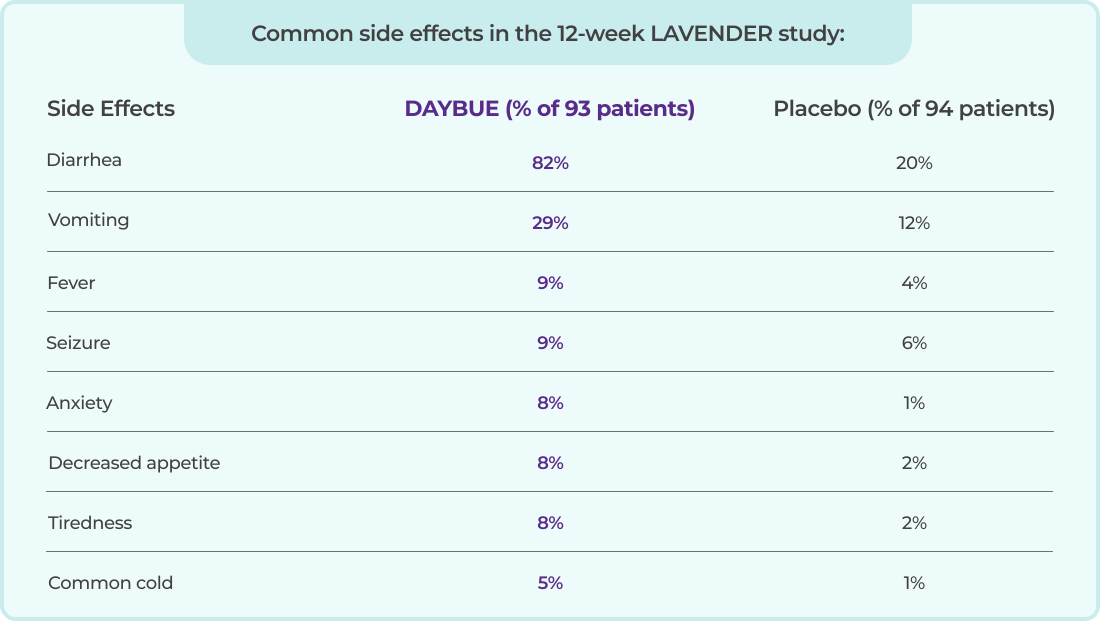
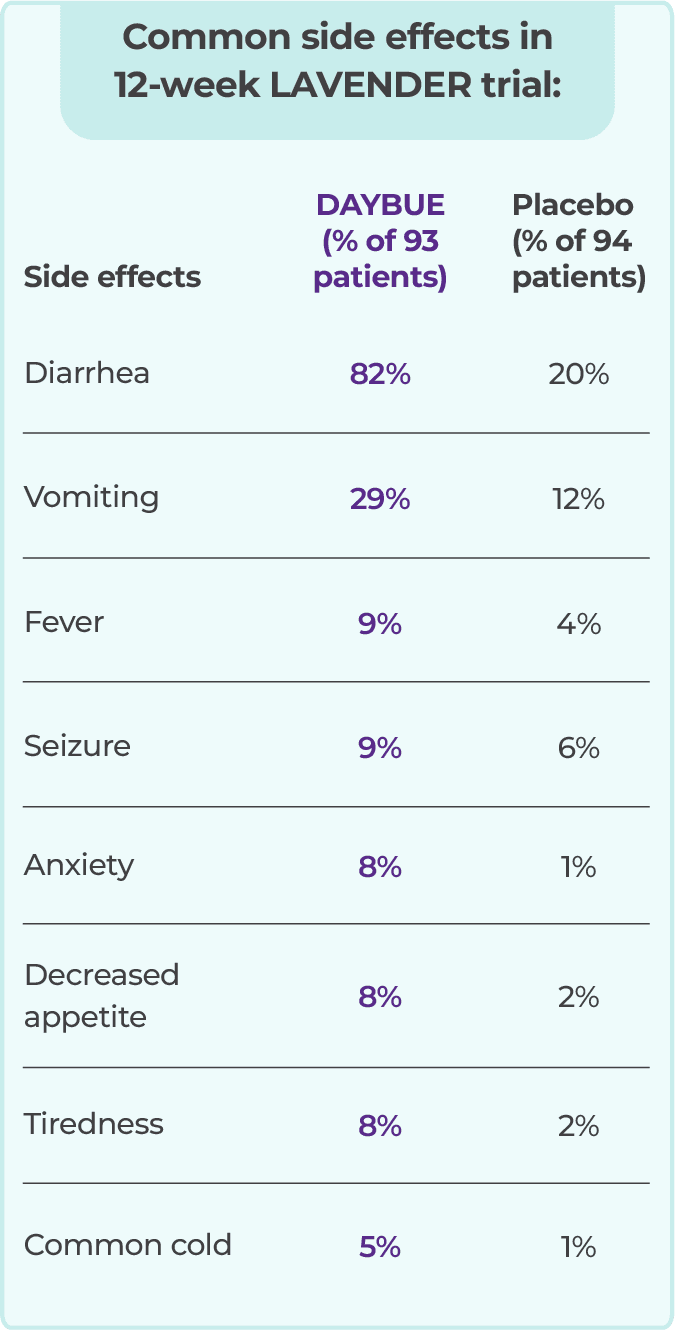
As with any medication, it’s important to talk to your loved one's doctor about the possibility of side effects with DAYBUE or DAYBUE STIX. Not every person will experience the same side effects, and for some people, certain side effects, such as diarrhea and vomiting, may be more severe than others.
Side effects may include:

Diarrhea:
Diarrhea is a common side effect of DAYBUE or DAYBUE STIX that can sometimes be severe. Diarrhea may cause your loved one to lose too much water from their body (dehydration). Before starting treatment with DAYBUE or DAYBUE STIX, stop taking laxatives. Tell your doctor if your loved one has diarrhea while taking DAYBUE or DAYBUE STIX. Your doctor may ask you to increase the amount your loved one drinks or give antidiarrheal medicine as needed.

Vomiting:
Vomiting is a common side effect of DAYBUE or DAYBUE STIX. Sometimes vomit can get into your loved one's lungs (aspiration), which could cause an infection (aspiration pneumonia). Tell your doctor if your loved one has severe vomiting or if vomiting happens often.

Weight loss:
DAYBUE or DAYBUE STIX can cause weight loss. Tell your doctor if you notice your loved one is losing weight at any time during treatment with DAYBUE or DAYBUE STIX.
Learn how to help manage possible side effects


Support by your side
Acadia Connect is a patient and family support program that connects you and your family with educational support and resources throughout the DAYBUE treatment journey.
Call Acadia Connect at 1-844-737-2223, Monday to Friday, 8am to 8pm ET, to learn more about our individualized support program designed to help meet the needs of your loved one taking DAYBUE.